
ROTARY DISTRICT 50406
Our Impact
Local action. Lasting connections.
Local action. Lasting connections.
Our fictional district’s service portfolio shows how clubs can work alongside community partners on practical needs, from reading support to healthier public spaces.
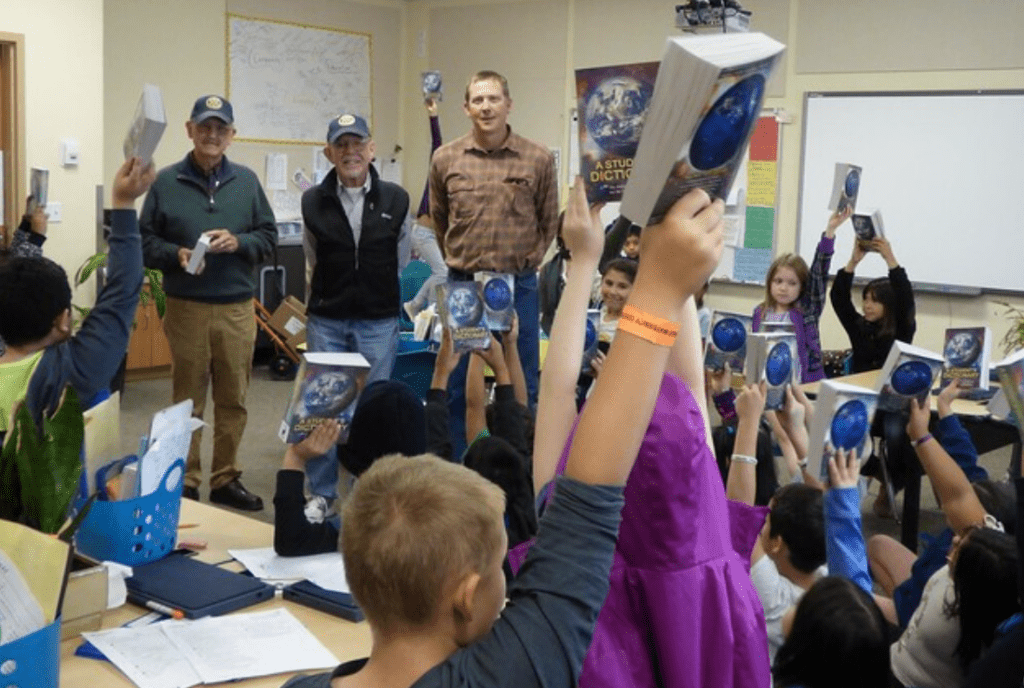
Learning together
The sample Reading Together project pairs club volunteers with a community learning center to provide books, reading sessions, and family literacy activities.
Restoring community spaces
The sample Riverbank Renewal project brings clubs and neighborhood volunteers together for litter removal and habitat stewardship, with work planned alongside local experts.
Connecting across borders
The sample Water for Learning project explores a partnership between Rotary clubs, a school community, and local technical advisers. Community priorities and a maintenance plan come first.
Turn an idea into a project
Identify a community need, listen to local partners, and define the outcome you want to achieve. Our Foundation and grants guide provides a starting point.
Stories from ClubRunner
Rotary at the Start of the United Nations
Officials from Great Britain, the Soviet Union, and the United States met in Moscow in 1943 and called for the creation of an international organization to maintain peace and security.
The next year, representatives of those countries plus China held conferences in Washington, D.C., to discuss how to go about this monumental task. Those sessions became known as the Dumbarton Oaks conference, where delegations from the four countries developed a proposal for the structure of the new organization.
After the conference, Rotary published “What Can Rotarians Do Following Dumbarton Oaks?” It included the proposed charter, talking points, and suggestions for discussing with club members how the United Nations would relate to Rotary’s goal of advancing international understanding. It also emphasized the importance of having a plan ready for when the war ended, rather than waiting until the fighting stopped.
After World War I, “proposals for international cooperation failed because of lack of enlightened public opinion to support them,” it explained. Discussions among members “will help to create an informed public opinion.”
“Timely Questions on Dumbarton Oaks” followed to help Rotarians understand the complexities of the proposed charter. The flyer presented different perspectives on the security council and other aspects of the UN as topics for Rotary club programs or discussions. At the same time, governments around the world were carefully studying and reacting to the work done at Dumbarton Oaks.
From April to June 1945, delegations from 50 nations attended the United Nations Conference on International Organization in San Francisco (often known as the San Francisco conference). Their task was to write a charter acceptable to all of them. The delegations were assisted in this historic effort by a large number of staff, advisers, and consultants.
Rotary International was one of 42 organizations the United States invited to serve as consultants to its delegation at the San Francisco conference. Each organization had seats for three representatives, so Rotary International’s 11 representatives served in rotation. The people officially representing Rotary included the general secretary, the editor of The Rotarian, and several past presidents. Other Rotarians from Africa, Asia, Europe, and North and South America served as members of their own nations’ delegations. Rotarians also served as consultants to their national delegations.
Just before the meetings began, Rotary International published and distributed the “Pattern for the San Francisco Conference” pamphlet. “It is a splendid opportunity for the individual Rotarian to fulfill the objective of International Service,” the document proclaimed, “by taking part in the debate on this scheme of world government.”
Read more here about Rotary History and the United Nations, on Rotary.org
History of Women in Rotary
Find the timeline and history of woman at Rotary International, on Rotary's official website Rotary.org here.
First Club in Philippines Opens Door to Rotary in Asia
Eight clubs were leading service efforts in the Philippines by the end of 1941. Iloilo Rotary members raised funds to build a hospital dormitory in Iloilo for patients with leprosy, also known as Hansen’s disease. Farther south, on the island of Mindanao, Davao club members organized a tree planting project to beautify their city.
Sometime during World War II, the Philippine clubs, like many Rotary clubs around the globe, ceased operations. All clubs in the Philippines were formally closed by the end of 1943.
Rotary was re-established in the country when the Dagupan club officially reopened in June 1945. The Manila club followed in October. By April 1948, all pre-WWII Rotary clubs had reopened and five new clubs had been chartered.
Find out more about the Clubs who opened the door to Rotary in the Philippines on Rotary Internationals website, here.
Rotary’s Response to the 1918 Flu Pandemic
In the United States, the illness was first identified in military personnel in the spring of 1918. The second, deadliest wave peaked between September and November of that year — the final stages of World War I.
Hospitals in some areas were so overloaded with flu patients that schools, private homes, and other buildings were converted into makeshift hospitals. In Chicago, where Rotary World Headquarters was then located, the number of new cases reached 1,200 a day at one point.
Several district governors reported at the June 1919 convention in Salt Lake City, Utah, that war work and then the flu greatly interfered with club activities and their club visits — but not with the spirit of Rotary service.
Illness and upheaval “prevailed all over the world,” Charles H. Brown, then governor for District 10 (Ohio), told the convention. “But throughout Ohio you will find the Rotary clubs, in every city where a Rotary club exists, in the foremost ranks of civic and social work, doing their full share toward serving our government and humanity.”
Read more about the District response and timeline to the 1918 Flu Pandemic here, on Rotary International's website, Rotary.org.
Young Inventor Eco-Friendly Bricks Come Full Circle
Binish Desai began working on an eco-friendly brick made out of recycling and waste, when he was 11. The former Rotary Youth Exchange student, inventor, and entrepreneur credits Rotary with giving him the support to pursue his dreams. Now he’s giving back through a new Rotary club.
by Geoffrey Johnson | photography by Chaitali Mitra
Growing up in Valsad, a city on the Arabian Sea in west-central India, Desai was also a fan of Dexter’s Laboratory, another animated TV show, this one about a boy scientist. “So I created my own lab in the corner of our living room in a TV cabinet. And I would always carry something called a ‘bag of ideas,’ where I would jot down different innovations of mine.”
For instance, having learned about evaporation and condensation in school, he noticed the steam that escaped from the pressure cooker when his mother prepared dinner. He created a device to capture that steam, which would then return to its liquid state — water that could be used for gardening. “That was my first invention ever,” he says.
“There is nothing that is useless in this world,” Desai insists. “The concept of waste does not exist in nature. It’s human consumption that creates it, so it’s our responsibility to get rid of it. And in the process of converting trash into treasure, we can also generate a lot of employment.”
In the nearly two decades since his Captain Planet days — Desai turns 27 this month — he has come up with more inventions; built and lost a company; founded, with his wife, several women’s empowerment centers; and generally concocted ways to improve the lives of everyone in his very broadly defined community. Central to his success has been his involvement with Rotary, a relationship that was sparked by a family connection and nurtured by a year in the United States as a Rotary Youth Exchange student. Now, as a charter member of the Rotary Club of Vibrant Valsad, his life in Rotary has taken flight.
Somebody hand that young man a cape.
A lifetime of inventing
He formed a new ambition: One day he would build the world’s least expensive house — and he would build it with bricks made of chewing gum and waste paper.
As Binish continued his scientific explorations, he kept inventing. “The one that led me to the person that I am today,” he says, “was the brick. That happened when I was 11 years old.”
One day in school, his best friend stuck a wad of chewed gum beneath a desk — and as fate would have it, the gum ended up getting stuck to Binish’s pants. He peeled it off as best he could and wrapped it in a piece of paper, intending to throw it away when class was over. Then he forgot about it. At the end of the day, when he finally retrieved it from his pocket, it was rock hard. “I thought, this is really different,” he recalls. “I said, OK, I can make stone out of this. I was just a curious kid trying to figure out, why did this happen?”
At this same time, in school, Binish was learning about how huge numbers of people were living in crowded and unhealthy slums. He formed a new ambition: One day he would build the world’s least expensive house for those people — and he would build it with bricks made of chewing gum and waste paper.
Over the days and weeks and years that followed, Desai experimented with different ingredients and proportions, always trying to build a better brick. With each iteration he sought to understand what was lacking and what could be improved. He made small molds out of cardboard and began designing and processing small, durable bricks, with plans to build a dollhouse. “I had no idea how,” he says. “I went to cybercafés and looked up stuff on the internet. That’s how I learned the basics about how to construct a house.”
When he was 15, Desai completed the dollhouse using his bricks. He had demonstrated to his own satisfaction that his plan to build the world’s least expensive house was sound. “I started talking about my plan to my family and my friends,” he recalls. “People started laughing about it. ‘You have gone crazy. How can you make something out of paper and chewing gum? It’s not going to work.’ ”
Finding confidence in Rotary Youth Exchange
At 15, Desai was a self-described introvert, and his self-esteem was low. With people laughing at his ideas, he had begun to doubt himself. But fate had another twist in store for the young inventor.
“In 2009 I got selected as a Rotary Youth Exchange student,” he says. “That’s why I owe a lot of who I am today to Rotary.”
Desai had applied for a short-term exchange, but things headed in a different direction when he went in for his interview. He told the Rotarians about his plans to build the world’s least expensive house, and he finally found the receptive audience he had been seeking. The Rotarians encouraged him to apply for a longer exchange, and he spent his junior year at Waukegan High School in Illinois, about 40 miles north of downtown Chicago.
One night, over a dinner of fried chicken, the floodgates opened. In an instant, the introvert had vanished, and he began telling his host parents, Patrick Jimerson and Theodora “Teddy” Anderson, about his bricks and his plans for the world’s least expensive house. After listening attentively, Jimerson asked if Desai had a patent for his bricks. (He did not.) He also suggested that Desai might want to pursue this as a career.
By the end of his exchange year, Desai says, he had transformed into a different person. “I was friends with everyone, and everywhere I went, I would talk to people. I made new friends because I started sharing my inner thoughts about how I viewed the world.” With Jimerson’s help, Desai secured a patent for the formula behind his bricks. And when he returned home to India, he knew the exact direction he wanted his life to take.
Jimerson died in 2016, but Desai returns to Waukegan each December to visit with Anderson, just as he promised Jimerson he would. “Rotary Youth Exchange changes you forever,” he says. “Once an exchange student, always an exchange student. Now I have a family all around the world.”
Founding an eco-friendly company
Back home, Desai announced his plans to start a company, called B-Dream, to manufacture his eco-friendly bricks from chewing gum and paper waste. The response was mostly negative. A profile of him in the local newspaper concluded (as Desai recalls) that he was “either an immense genius or the craziest person I’ve ever met. Only time will tell.”
Even his parents expressed their doubts, convinced that their son was going to throw away his life on an “imaginary” endeavor. Part of their concern stemmed from their fears about how the rest of Valsad would view his plans. “My family had quite a name in the community,” says Desai. “Someone working with waste and coming from a family that was socially prominent was kind of taboo. ‘Hey, he’s bringing down the family’s name.’ All that pressure made my parents think they could not support this craziness of mine.”
Desai was undeterred. After graduating from high school, he enrolled at Veer Narmad South Gujarat University, where he would earn a degree in biotechnology. (He would go on to earn an advanced degree in environmental engineering.) While working toward his undergraduate degree, he persuaded a local paper mill to let him take over a small abandoned parking lot on its property. The mill was already paying a large sum to another company to haul off its paper waste; in exchange for the lot and a significantly smaller sum of money, Desai agreed to haul away some of that waste himself. He also persuaded a chewing gum manufacturer to give him its offcut waste. (In the process of making chewing gum, Desai explains, some of the gum base is cut and thrown away before the sweetener is added.) With those materials and his patented blend to hold them together, Desai now had everything he needed.
Working in the open parking lot, Desai began making bricks. “I was the labor,” he says. “I would only get in two to three hours a day, because it would be evening by the time I reached the place. Working there was difficult, and then I had to go back home because I had an early morning train to catch to school.” Despite the difficulties, after eight months, he had 4,000 bricks. The paper mill needed a watchman’s cabin, which Desai built, successfully demonstrating the feasibility of his vision. (Eventually the cabin was dismantled and the durable bricks were used to build the office from which Desai works today.) “I had made my first house,” says Desai. “Now it was time for me to start mass production.”
Learn more about Binish Desai and his story here on Rotary.org
Rotary projects around the globe – August 2026

Canada
The annual used book sale of the Rotary Club of Sarnia-Bluewaterland in Ontario has been a fixture for more than 25 years. “We all realized we were in this because we loved books, we wanted to encourage others in the community to access great books at a reasonable price, and, yes, it was a wonderful way to generate funds to support local nonprofits,” says coordinator Dale Wilcox. In January, the sale raised more than US$42,000, with leftover books being distributed to several organizations and groups, including a Canadian Armed Forces unit stationed in Latvia. “Troops are already digging into the massive collection and finding a good book to keep at their bedside or take into the field,” Lt. Col. Colleen Grebstad reported in a letter to the club.
District 50406 is a fictional demonstration. Program examples are illustrative; connected listings come from a ClubRunner demo account.